

News
Contact UsNews
Contact UsHow to Install Laminate Flooring on Concrete: Step-by-Step Guide for Moisture Control
-
 author
- 04 June 2026

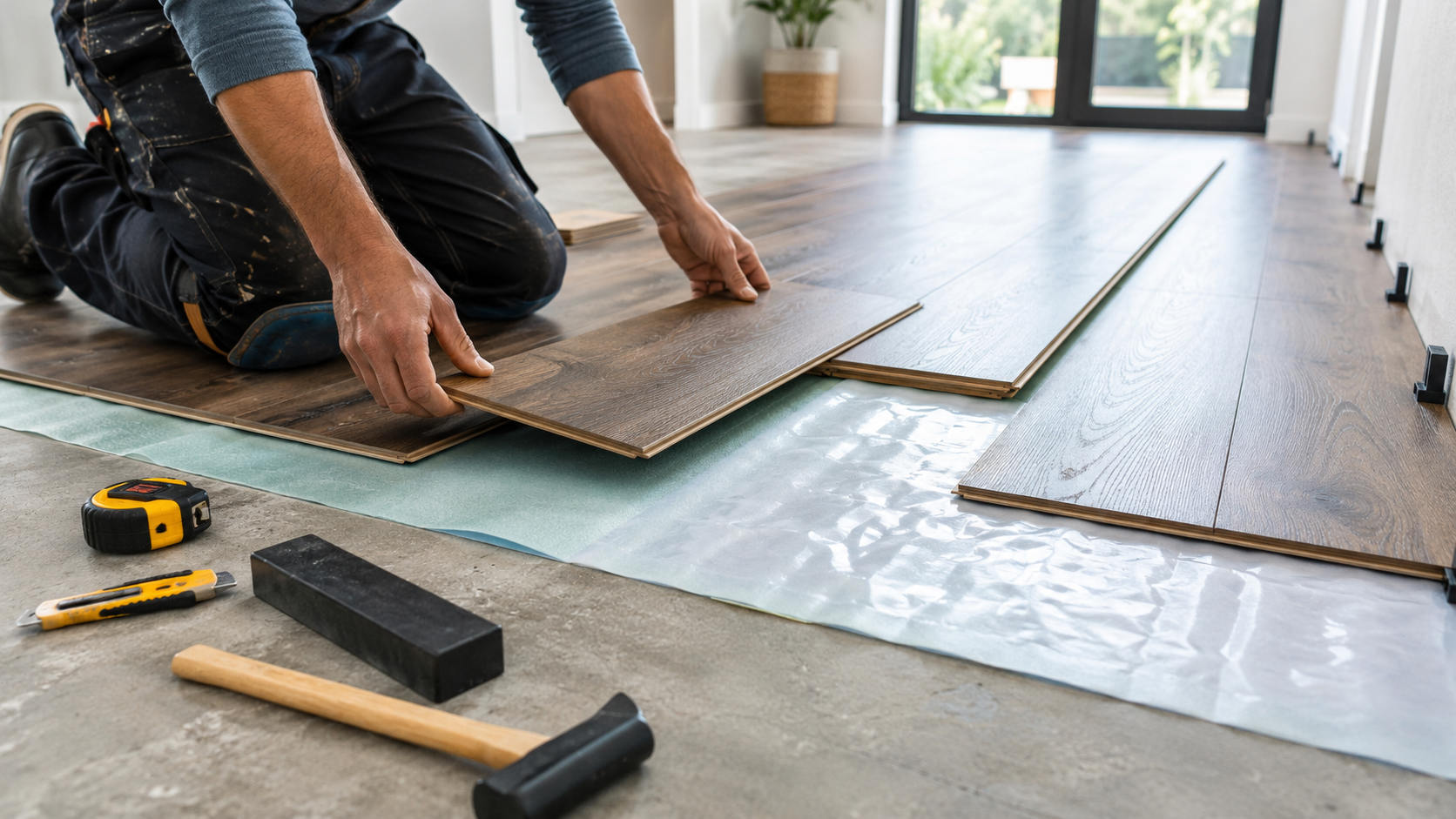
When installing laminate flooring on a concrete subfloor it is crucial to understand the moisture aspects of concrete. As concrete matures it releases vapor into the air. This can cause problems for your flooring, potentially leading to warping, delaminating or even mold. Installing laminate flooring on concrete presents many challenges to the professional installer, including dealing with vapor transmission, an uneven subfloor and residual adhesive from previous flooring. With proper subfloor preparation, the use of the correct flooring and moisture mitigation strategies, laminate flooring is a very durable product that can provide a great looking floor in high humidity areas like basements as well as on ground level slabs.
Can You Install Laminate Flooring Over Concrete?
Laminate flooring can be laid over concrete as long as the concrete slab is clean, level, dry and has moisture protection. Since even a dry-looking concrete slab can release vapor, it’s crucial to carry out moisture tests and use an adequate vapor barrier or moisture-resistant underlayment. Most laminate flooring is installed as a floating floor which allows the floor to expand and contract with normal changes in humidity. This type of floor is very stable over time.
What Preparations Are Needed Before Installing Laminate Flooring on Concrete?
Before you start to install laminate flooring on a concrete floor it is a good idea to test the floor to establish whether it is suitable for installation.
Evaluating the Concrete Subfloor Condition
Check the concrete floor prior to laying laminate flooring for cracks, spalling or other structural damage which could cause the flooring to move. Also, make sure to scrape off all old adhesives as well as other dirt and dust residues from previous floor coverings in order to guarantee a good adhesion of the underlayment. The floor must be free from any dirt, dust, grease, etc. as well. To check for flatness, use a long straightedge or a laser level and note the manufacturer’s allowed deviation, usually max. 3 mm/2 m, in order to prevent floorboards from bending or to avoid any noise that may occur during walking.
Testing Moisture Levels in Concrete
An initial moisture test must be carried out before laying laminate flooring on a concrete floor. For this type of flooring there are two types of tests which can be used to check the moisture emission of the concrete floor, the calcium chloride test and the in-situ relative humidity (RH) test. The results of both of these tests can then be compared with the flooring manufacturers’ specification for that particular laminate flooring product. Typical recommended values for laminate flooring products are 3 lbs/1,000 sq ft/24hrs using a calcium chloride test or 75% RH using an in-situ RH test. Should the test results indicate that the moisture emission is higher than recommended then additional specialized vapor barrier flooring can be laid down in affected areas or a topically applied sealer used to prevent such high moisture emission in future.
How to Install Laminate Flooring on Concrete: Step-by-Step
Once the concrete has been checked, cleaned and tested for moisture, the installation can move forward in the following order.
Step 1 – Inspect the concrete subfloor
Step 2 – Clean and repair the surface
Step 3 – Check subfloor flatness
Step 4 – Test concrete moisture
Step 5 – Install the appropriate moisture barrier
Step 6 – Install underlayment if required
Step 7 – Acclimate the laminate flooring
Step 8 – Plan the first row and expansion gaps
Step 9 – Install and lock the planks
Step 10 – Install transition, basements and moldings
How Can Moisture Be Controlled During Installation?
Once you have evaluated and tested your subfloor to find out where you are with it, you can then start to look at ways to control moisture to try and get the best from your subfloor in the long term.
Choosing Appropriate Vapor Barriers and Underlayments
Selecting the right type of moisture barrier for laminate flooring installed on concrete can be critical. A 6-mil polyethylene sheeting is typical and found in roll form – 6-mil and larger. It should be installed flat on the slab, covering the entire floor. The seams should be overlapped a minimum of 8-inches and then taped with waterproof tape to create a seal. A very good alternative to a separate moisture barrier would be an integrated underlayment with built-in vapor protection. This would make for a very good underlayment for residential applications where sound reduction and good thermal insulation are primary concerns.
Best Underlayment for Laminate Flooring on Concrete
In addition to installing a vapor barrier, selecting the best underlayment is crucial in providing moisture protection, comfort while walking, sound reduction, and long-term floor stability. When it comes to concrete subfloors, the optimal underlayment should have good cushioning properties while also assisting in the moisture flow from the slab.
IXPE underlayment is one of the most common underlayment used in laminate flooring on concrete. It is a closed-cell underlayment that offers good moisture protection and long lasting cushioning and sound absorption. IXPE underlayment is very light weight making it very easy to cut to size as well as install. It is suitable for residential jobs as well as commercial / renovation jobs. Having an attached vapor barrier or moisture-proof film makes installation a breeze and offers superior protection of the concrete.
Cork underlayment is an alternative solution to synthetic underlayment for homeowners preferring to use natural materials. Acoustically, it performs very well and reduces impact noise, in addition to providing very comfortable walking properties. However, being more sensitive to moisture than synthetic underlayment it should not be used on above ground timber floating floors, and only on properly sealed concrete, with an adequate vapor barrier such as plastic or bitumen below.
EVA underlayment is also used in laminate flooring installations, since it is soft and cushioning, has some sound reducing qualities and is very flexible. It is suitable for budget-conscious projects, but then do check the density, the compression resistance and the moisture protection layer, especially when laying on concrete. A low-density EVA will compress over time and then this floor will not be as stable as you would like it to be.
For concrete installations, IXPE underlayment with built-in vapor protection is generally the best middle-of-the-road choice, providing best protection against moisture, comfort, durability, and easiest installation.
Applying Moisture Sealers or Primers to Concrete
When high moisture is found during the testing phase, an epoxy-based or polyurethane-based sealer can be used to reduce the amount of vapor that passes through the slab. These products create a hard, surface film that will allow time for the surface to ‘stabilize’ prior to application of the underlayment. The recommended cure time for the sealer must be allowed prior to application of the underlayment. In addition, it is very important to verify that the type of sealer used is compatible with the type of underlayment that will be used for the flooring to ensure proper adhesion of the flooring system.
What Are the Key Steps in Installing Laminate Flooring Over Concrete?

The execution of the floor installation is critical after preparation and ensuring moisture control has been achieved in order to gain the desired aesthetic and structural properties of the floor covering.
Acclimating Laminate Planks Before Installation
Laminate floor planks have to acclimate to the room conditions for at least 48 hours before they can be fitted. This period enables the floor covering to reach the equalization with the room temperature and the humidity. Equalization is to be achieved in an constant room condition within the 48 hours. This means dry rooms with indoor temperatures of 18° up to 27° and relative humidity of 35% up to 65%.
Laying the First Rows of Laminate Flooring
We start laying the floor from the longest wall in the room and use this as a straight reference line to align to. It is also important to allow for expansion at the flooring edges near fixed objects such as walls or columns. Typical expansion is around 10–12 mm and is achieved by the use of spacers to ensure that there are consistent gaps between the individual flooring planks in each row. The effect is a uniform appearance to what is likely to be a large floor area.
Locking Planks Together Efficiently and Securely
Laminate floor planks lock by means of the tongue-and-groove joint and must be locked with great care in edge position, since there is a risk of chipping or wrong alignment. Tapping blocks may be used to lock the planks but must be used with care. When tapping too hard there is also a risk of damaging the click joint. Stagger the end joints of consecutive rows of floor covering a minimum of 12 inches. Cut the end of the last row of planks strictly in accordance with the manufacturer’s instructions for proper fit and for the required expansion space in all rooms around the perimeter.
How Should Expansion Gaps and Finishing Details Be Managed?
Controlling the expansion allowance of your laminate floor is crucial during periods of humidity change in the course of the seasons to guarantee the safety of your floor.
Managing Expansion Gaps Around Perimeters and Fixtures
Make sure all the perimeter gaps are left open in each room and use the necessary transition strips at the doors and where there are transitions from one floor covering to another. These transition strips will allow the free movement of the two adjacent surfaces without the hazard of tripping. NEVER fill the perimeter gaps with grout or silicone sealant as this would prevent the necessary movement of the floor covering.
Installing Baseboards and Moldings Professionally
Baseboards should be installed after the floor installation. They should be fixed to the walls and not through the laminate floor surfaces. This allows the flooring to expand and contract freely under the attractive trim work. Minor filling of aesthetic gaps such as stair nose ends can be completed with a small amount of a good quality, flexible caulk.
How Can Long-Term Performance Be Maintained After Installation?

To ensure that laminate floor coverings last for a long time even when they have been installed on top of a concrete floor base, continuous environmental management and proper maintenance by using specific methods and measures for laminate floor coverings is required.
Controlling Indoor Humidity Levels Year-Round
Try to maintain Indoor RH between 35% and 65% throughout the year. This will prevent objects from shrinkage as they dry, as well as from swelling as they become wet. This can be accomplished by use of a dehumidifier in basements and wet areas, or by controlling humidity through your central air handling unit.
Cleaning and Maintenance Practices for Laminate Flooring on Concrete
To maintain your flooring keep it dry. Seepage of water into the seams can cause the flooring to swell or delaminate over time. Use a damp mop as required and use a cleaning solution recommended by the manufacturer for use on laminate type flooring finishes. Do not use waxes, polishes or abrasive pads as they can quickly dull the finish.
Can You Install Laminate Flooring in a Basement?
Laminate flooring can be used in a basement, but don’t judge the concrete only by how dry it looks. A slab may still release moisture, especially in a below-ground space. Testing first is a safer way to know what you are dealing with.
If the basement has had leaks, seepage, or water sitting on the floor, laminate may cause trouble later. In a basement that stays dry, it can still be a workable option. The concrete should be flat, and some form of vapor protection should be placed under the floor before installation.
Choosing the Right Laminate Flooring Supplier for Concrete Subfloors
For a concrete floor project, buyers should not choose laminate only by color or design. The locking system, moisture resistance and stability of the board are also important. Installation information should be checked as well, especially for renovation or commercial use.
Lumiwarm works with flooring manufacturing partners in China. It helps overseas buyers source laminate flooring, check product details and follow quality requirements before shipment. Export arrangements can also be handled according to the order.
Conclusion
To be considered a professional at installing laminate flooring on concrete, it is crucial to start by preparing the subfloor and testing for moisture before choosing a vapor barrier and allowing the flooring to acclimate. By following the best practices of the flooring industry, you can avoid long term problems such as laminate flooring warping or delaminating due to vapor that has been trapped under the flooring. Your floors will last for decades and still look and perform great.
FAQs
1.What is the ideal moisture level in concrete before installing laminate flooring?
The emission of moisture from the concrete should be below 3 lbs/1,000 sq ft/24 hrs using a calcium chloride test or less than 75% relative humidity as specified by the manufacturer.
- Can you install laminate flooring directly on concrete?
Yes, but the concrete should be clean, dry and level first. Moisture protection is also needed because concrete can release vapor into the flooring. Laminate is usually installed as a floating floor over a vapor barrier or suitable underlayment rather than simply being placed on the bare slab.
3.How long should I wait after applying a concrete sealer before installing laminate flooring?
The recommended wait time to allow the seal to dry before applying underlayment for the planks is between 24 hours and 72 hours depending on the type of sealer that you are using and the ambient environmental conditions. Once the seal has completely dried you can continue to assemble the plank system.
4.Is Laminate Flooring Suitable for Basements?
Yes, laminate flooring can be suitable for basements, but the concrete must be dry, level, and covered with a vapor barrier or moisture-resistant underlayment. It is not recommended for areas with flooding risks or standing water.
5.What Happens If Moisture Gets Under Laminate Flooring?
Water under laminate flooring can cause flooring to swell, warp, pull up from edges and crowns of flooring to open up at joints and cause black mold growth. Therefore, it is critical to test for moisture and to install proper vapor protection prior to installation of laminate flooring.
6.How Thick Should Underlayment Be for Concrete Floors?
Typically, laminate underlayment for concrete floors are around 2 mm to 3 mm thick. It’s important to have a moisture barrier, stable base and adequate sound reduction.
7.Is Laminate Better Than Vinyl Flooring for Concrete Slabs?
Laminate flooring gives a warmer appearance than vinyl and has a more natural look and feel of real wood. For dry concrete flooring such as a concrete slab, laminate flooring would be a better option. For wet areas such as bathrooms and kitchens, vinyl flooring is more resistant to water and generally safer.

Our Products
Our Products


our testimonials
What They Say About Our

“Super patient throughout communication—efficient and professional. This collaboration was so hassle-free!”

“Both quality and service exceeded expectations. The details are on point—I’ll definitely recommend it to friends!”

“Delivered right on time, and the product matched every detail we discussed. Totally satisfied!”


